
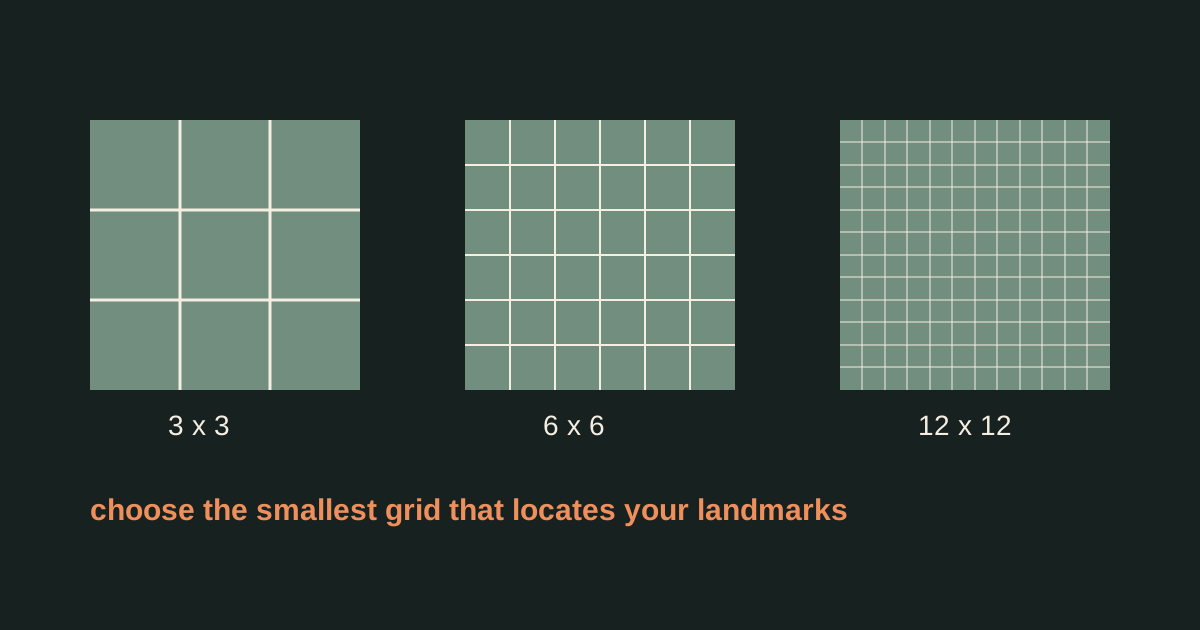
There is no universally correct drawing grid size. The right number of squares is the smallest grid that lets you locate the subject's important landmarks without guessing. A dense grid can improve placement, but it can also hide the larger shape you need to see first.
A practical grid size guide
| Grid | Best starting use | What it helps you check |
|---|---|---|
| 3x3 | Simple objects and broad composition | Overall placement and negative space |
| 5x5 | Beginner studies and still life | Large contour changes and shadow blocks |
| 6x8 | Portraits and vertical subjects | Eye line, nose, mouth, and jaw position |
| 8x6 | Landscapes and horizontal scenes | Horizon, building edges, and foreground spacing |
| 10x10 | Detailed transfer work | Smaller landmarks and irregular contours |
| 12x12+ | Complex linework or large murals | Dense intersections, lettering, and tiny features |
These are starting points, not rules. A simple portrait with a large hat may need fewer cells than a plain face with subtle feature differences.
Use landmark density, not habit
Count the landmarks that must be placed accurately. In a portrait, these may include the top of the head, eye line, inner eye corners, nose base, mouth corners, chin, and jaw turns. If a 5x5 grid places several of those points in the same cell, move to 6x8 or 8x10.
For a landscape, count the horizon, major roof lines, tree boundaries, and the foreground/background transitions. More rows do not help if the important information is mostly horizontal; add columns or choose a rectangular grid instead.
Check the physical cell size
A grid should remain usable on the paper. If your drawing area is 20 cm wide and you choose 20 columns, each column is only:
20 / 20 = 1 cmThat may be useful for a detailed transfer, but it is uncomfortable for a beginner working in pencil. A 10-column grid gives 2 cm cells on the same paper, leaving enough room to see and measure each shape.
A five-minute selection test
Before committing to a grid:
- Preview the image with a 5x5 grid.
- Mark three or four important landmarks.
- Ask whether two landmarks share a cell and still need separate placement.
- Increase the grid only if the answer is yes.
- Step back and confirm the subject is still readable through the lines.
This test is faster than starting with a 20x20 grid and discovering that the reference has become visually noisy.
When a rectangular grid is better
Use different row and column counts when the image is not square. A 4000 x 3000 pixel landscape can use 8 columns and 6 rows, giving:
4000 / 8 = 500 pixels per column
3000 / 6 = 500 pixels per row
The cells stay square while the composition keeps its 4:3 ratio. Stretching the image to make a square grid is almost always worse than using a rectangular count.
Related tutorials
- Add a grid to a photo online and test multiple densities before exporting.
- Portrait drawing with the grid method for feature placement.
- Grid drawing for beginners for a focused first exercise.
Choose a grid that gives you enough information to make the next mark, but not so much information that you stop seeing the whole drawing.